
Strong Identity, Loosely Held
An exploration in internal identity politics

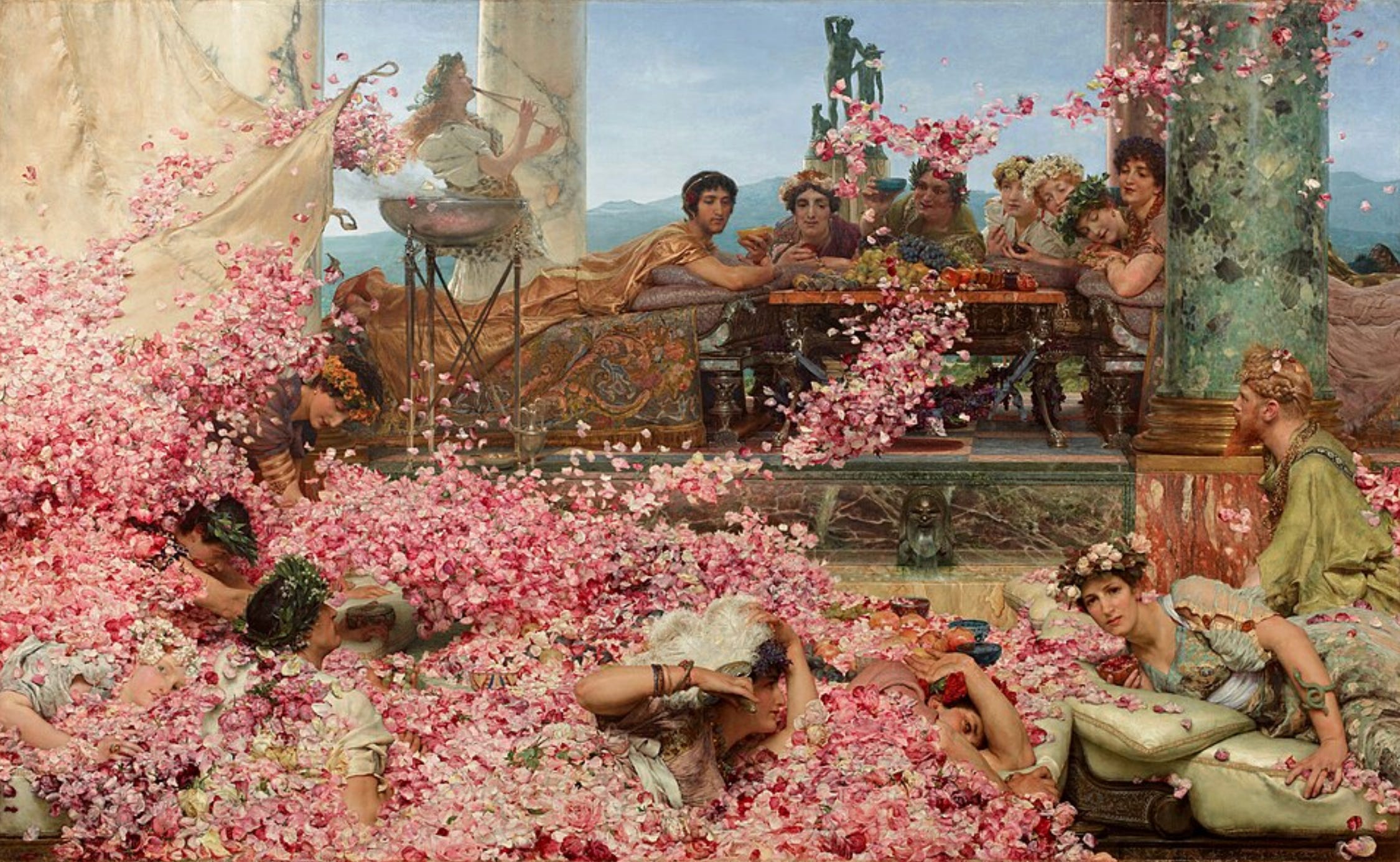
“The Roses of Heliogabalus” by Sir Lawrence Alma-Tadema
I’ve been playing a lot with the idea of what I’m calling internal identity politics: the ways we relate to our own identity, and the wars we have within ourselves. How do we govern, defend, and legislate the stories we tell to ourselves about who we are, and the evidence we seek to support those stories? The more I play with the concept and reflect, the more I see it functioning similar to how external politics do, with its platforms, allegiances, hardened positions, and a deep resistance to being caught changing our minds, even if no one else can see the conversation going on inside of us.
A friend of mine is in the middle of a lawsuit from a case of generosity gone awry that’s eating up a lot of his time, energy, and peace. His motivation to stick with it and see it through is largely driven by his desire to defend his character and see justice served—to get the money and the narrative he’s owed, which are both substantial in value. To that, he says, “I don’t settle.” I was struck by those words because it’s an identity position more than it is a legal position. A statement about who he is, dressed up as a statement about what he’ll do.
Once a decision is being made by your identity rather than by your judgment, you’re not necessarily deciding anymore, because the story is deciding for you.
This made me think about the self-confrontation I went through during my divorce, when I thought I knew what that process would look like and what the outcome would be. I had a picture of how things would go (how the assets would divide, how we would treat each other along the way, and what my life would look like on the other side), and it didn’t always go that way. In fact it went a different direction, and it went there fast, leaving me little time or room to negotiate with reality.
So in confronting reality, I had to confront myself and decide what I valued the most: getting out and starting the next chapter of my life, which is what my inner compass was telling me to do, or getting out with a certain amount of “stuff,” and fighting tooth and nail for who knows how long to get it, which is what my ego was telling me to do. Eventually, I realized I valued time-to-freedom over the negotiation of fairness, and in doing so I had to trust that things were going the way they were for reasons I couldn’t yet see. Ram Dass talks about how our souls are negotiating karmically beneath the level of conscious decision, and that things we experience as accidents or losses have often been agreed to somewhere we don’t necessarily have conscious access to. I find that framing useful, whether or not it’s literally true, because it points to something I felt: that whatever was happening to me had already been worked out by a part of me (or God, but same thing) that knew more than the part of me suffering through it.
In hindsight, my inner compass was correct. I needed to be taken down to the studs. The slate had to be cleaned to make room for what was coming, and what still is coming. If I had held the line of I don’t lose, I would have won my way right out of the lesson. And life is so relentlessly patient, isn’t it? It will bring the lesson again, in louder and bigger forms, until we hear it. The karmic bill of not listening always compounds.
Self-concept as narrative
Identity, or our self-concept, is a story that we craft and maintain over time. And narrative just might be the most powerful cross-spectrum force humans have on this planet. It’s the operating system underneath everything we do and think. It’s the thing we use to create movements and to start wars, to heal ourselves and to trap ourselves, to build something honest and to construct elaborate self-deceptions. And the story we tell to ourselves about ourselves is just another narrative pointed inward.
Jung had a useful word for the public-facing version of this story: the persona, or, the mask. He didn’t mean this pejoratively, because we all need our masks to move through the world. The trouble starts when we’re no longer able to tell the difference between the mask and the face. Jung’s idea of individuation was about loosening that fusion and becoming more fully oneself by being willing to let go of the self one had assumed one was. It’s only when we see the costumes that we are wearing that we can consciously decide to take them off; and, when to put them back on. He also had this idea of the complex: that an emotionally charged cluster of associations can take over and run the show without you noticing. Which begs the question, when does conviction actually become compulsion? It’s a hard line to find, because from the outside, and even from the inside, they can look identical. Both hold the position and refuse to budge. But the difference, I think, is in what happens when you press on it. Conviction can usually stay in relationship with reality, but compulsion has to defend itself from reality.
Inside of myself, I inquire about this a few ways. First, can I explain why I hold the position without getting bent out of shape about it? Conviction is logical and calmly articulate, and can usually explain itself without panicking. Compulsion has its reasons too, but they arrive swiftly, defensively, slightly over-rehearsed, and they often circle back to who I am rather than what’s true. Second, can I imagine doing the thing I say I won’t do? Conviction can run that entire mental rehearsal and come back with a clear no. Compulsion can’t get through the first frame without flinching, because for the complex, just imagining it is a betrayal. Third, and this is the most useful one, what happens if I imagine doing the thing and nothing bad results? If the thought of settling, losing, walking away, or asking for help feels intolerable even in a fantasy where it turns out fine, that’s a strong signal you’re not dealing with a value. You’re dealing with a part of you that has decided this position is load-bearing for the self, and any threat to it gets treated as a threat to your self-concept. “I don’t settle” said with conviction sounds like a value, whereas “I don’t settle” said from a complex sounds like a barrier, built up because something else behind it is afraid.
Steiner staged the same dynamic as a more mythic encounter. He believed genuine inner development requires encountering what he called the Guardian of the Threshold: the figure that appears at the edge of transformation, carrying the full weight of what in us remains unresolved. The Guardian is a shadowy figure—the old self made visible, constructed from the accumulated consequence of everything we have been unwilling to see—asking whether we are really prepared to cross into a larger life, and maybe even trying to convince us to turn around. Whether or not one accepts the metaphysics, the psychology feels true. We all know that inner guardian. It’s the voice that calls itself discernment when it’s actually fear,, or self-respect when it’s armor. Often what we mistake for guidance is the immune system of an outdated identity, attacking the future as if it were some sort of infection.
The council of selves
The more I sit with all of this, the more I think the word “identity” is misleading us by being singular. It suggests one thing, one self, one story. But anyone who has paid close attention to their own inner experience knows it’s not like that. There’s a part of you that wants the fight and a part that wants the exit. A part that wants to be seen and a part that wants to disappear. A part that’s still seven years old and a part that’s already 90. They don’t always agree, and they don’t take turns politely.
I just started a new therapeutic modality called Internal Family Systems (IFS), or “parts work,” after noticing that my psyche was naturally favoring certain parts and identities—some that were helpful, and some that were acting out because they weren’t getting enough attention. The basic premise is that we are not singular. We are plural, containing a kind of internal system of selves, each with their own agenda, their own history, their own idea of what’s required to keep us safe. What we call identity, in any given moment, is often just whichever part has currently grabbed the microphone.
There are factions inside us. Alliances. Parts in power and parts in exile. Protective parts that have appointed themselves spokesperson for the whole system, often without consent from the rest of it. And, just like in the political world outside of us, the loudest voice is rarely the wisest one. It’s usually just the one most afraid of losing its seat.
When my friend says “I don’t settle,” that’s obviously not the whole of him talking. That’s a part, probably a protective part, that has done good work for him in many contexts. Same with the version of me, during my divorce, who initially wanted to plant the flag and fight every inch, but was beat out by the part desiring a fresh start.
The work isn’t to silence any of these parts or to pretend they aren’t there. It’s to know them well enough that you can tell which one is currently speaking or pulling strings in your psyche and life, and to decide, from somewhere underneath and across all of them, whether that’s the right voice for the moment. That underneath place (IFS calls it Self with a capital S, Steiner would call it the higher I) is the thing we’re actually trying to govern from: the whole.
Giving the future self a vote
The move is something like strong identity, loosely held, borrowed from “strong opinions, loosely held,” which I’ve always liked as an epistemic stance, and I think it transfers. The point isn’t to have less identity. A weak identity can be its own problem, where one is drifting, formless, blown around by whoever’s in the room. You need to know what you’re about. The question is how tightly you’re gripping it, and which part of you is doing the gripping.
To hold yourself loosely can mean a few things, practically. It can mean treating your self-concept as a working hypothesis rather than a verdict. It can mean being able to notice when a phrase like “I don’t lose” or “I don’t settle” is doing the decision-making for you, and being willing to ask, is that still true, and is it true here? It can mean letting your identity update with new information instead of only recruiting new information to defend the old version. And it can mean learning to tell the difference between the values that are genuinely yours and the postures you adopted at some earlier point to survive something, and which you’ve been carrying since out of habit.
The world keeps offering us new chapters, and we can’t enter the next one wearing the wardrobe from the last. A divorce, a lawsuit, a career ending, a move to a new city… these are all moments when reality asks us to take a new shape. And identity, like any incumbent, usually resists. It campaigns for continuity, it mistakes the old platform for integrity, and it loves to mistake its own survival for ours. This is where the real work begins: in refusing to let any one of them govern alone. The part that says “I don’t settle” may have wisdom, and the part that says “I don’t lose” may have once kept us alive. But no single part should be allowed to confuse its fear with the whole truth.
The self we’re protecting is almost always the self we’ve already been. The self we’re becoming hasn’t earned that kind of loyalty yet, which is part of why becoming is so hard. We are asked to extend trust toward a life we cannot fully see, on the word of some deeper intelligence in us that knows before the rest of us is ready. Maybe that is what it means to have a strong identity, loosely held: to know what you stand for, but not mistake every stance for the soul. Can you let your values remain strong while your story stays permeable? Can you face the Guardian at the threshold and understand that its fear is not proof you should turn back?
Most of the time, we don’t get to choose what life puts in front of us, but we do get to choose who inside us gets to answer. And maybe the goal is to learn to answer from the whole, rather than from the part still trying to protect a life we have already outgrown.
I love taking g this walk with you, Grace!
what a joy to get a peek inside your brain, and in many ways to see my"self" reflected. thank you for writing and sharing!